New consumer rules in six markets are changing how digital services handle cancellations, pricing and human support. Most of the changes land in 2027. The UK and California start in January, and Australia follows in July. The European Commission tabled its own proposal on 11 November 2026. Customers will meet these rules on their screens, and support teams will be the ones answering for them.
For gaming studios and digital brands, this isn’t only a legal project. It’s a support project with a deadline.
Three pressure points, six markets
The laws differ from market to market, but the same three ideas keep showing up.
- Leave easily. Cancelling online should be as easy as signing up, with reminders before a subscription renews.
- See the real price. Prices should be clear, without misleading pricing tricks.
- Reach a human. Where the rules require it, a customer should be able to reach a person, not loop endlessly through a bot.
Why now? A European Commission study found deceptive design on 97% of popular websites and apps. The Commission’s later review put the cost to consumers at a minimum of €7.9bn a year.
What lands where, and when
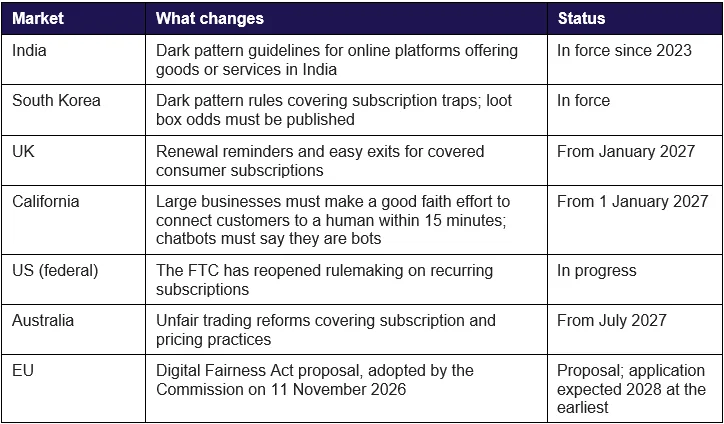
The EU proposal still goes to the European Parliament and the Council, so its details and timing may change. The Commission says it targets hard cancellations, automatic renewals, free trials that turn into paid plans without warning, misleading pricing, addictive design, practices that encourage overspending, and “the inability to reach a human interlocutor for customer service”.
It’s not just the store. It’s inside the game too
Games feel this in three layers: inside the game (virtual currency, loot boxes, paid progression), in the store and subscriptions, and in customer service.
Most markets touch one or two of those layers. South Korea already requires published loot box odds, and Australia rates games with paid loot boxes M or higher. The EU proposal is the broadest. It covers practices that encourage overspending, extra protection for children, pricing and access to a human, so it can reach all three layers at once.
For a live service game, that means the shop, the battle pass, the renewal email and the support desk may all need a change on the same timeline.
The biggest change for support: a human, on request
From 1 January 2027, large businesses in California must make a good faith effort to connect a customer to a human within 15 minutes, or book an appointment within one business day. Chatbots must identify themselves as bots.
It’s not alone. The EU proposal names reaching a human as a problem to solve, and New York City has proposed rules against AI “doom loops”, where a customer can’t get past the bot.
That changes the job of support leadership in two ways. Time to human becomes a number you have to prove, not just a target on a dashboard. And who answers matters as much as how fast: a person who knows the game, speaks the player’s language and has the authority to fix the problem.
Automation still has a big role. What changes is that the exit from it stops being optional.
Why the support queue feels it first
Customers rarely read regulation. They notice the change on their screen, and some of them get in touch. Each rule tends to bring its own questions, for example:
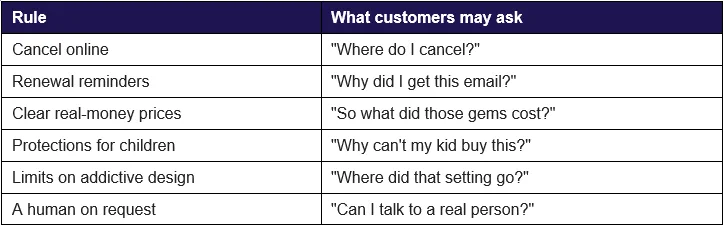
These are illustrative questions, one per rule.
Five moves that work whatever the final text says
- Map the contacts. List the new questions each rule could create, by market. Write the answers before launch, in every language you support.
- Design the handover. Decide when the move to a human triggers, how fast it happens and in which languages. Then test it like a feature.
- Give agents authority. Let agents cancel, refund or pause within clear limits, in one contact. A human who has to escalate everything doesn’t solve the problem the rules describe.
- Measure and prove it. Track time to human, cancellation completion and repeat contacts, per market. If a regulator or a customer asks, you want the numbers ready.
- Cover every hour. “On request” doesn’t stop at 17:00. Players in different time zones will ask at 3 am, and the rule doesn’t say “during office hours”.
Some moves raise a practical question though: can you afford a human in every language, at every hour? It’s where many teams feel the strain first. In one long-standing 5CA partnership with a game studio, AI translation with custom game glossaries let agents answer players in their own language, around the clock. The result was a 21% total saving for the entire operation, while player satisfaction stayed above 90%. Translated tickets are quality checked, so a person still owns every answer.
Build your support playbook for 2027
Regulators write the rules. Support teams make them work, in every market, language and hour. If you’re planning how your support operation will handle 2027, we’re happy to connect. Let’s connect
This article is for general information and is not legal advice. Status as of 12 November 2026; proposals and dates may change.
Sources
- European Commission, Digital Fairness Act proposal (11 November 2026)
- European Commission, behavioural study on unfair commercial practices in the digital environment (2022)
- European Commission, Digital Fairness Fitness Check (October 2024)
- PYMNTS, summary of California AB 1609 (28 October 2026)
- New York City Department of Consumer and Worker Protection, proposed rules (20 October 2026)
- US Federal Trade Commission, rulemaking on recurring subscriptions (March 2026)
- UK Digital Markets, Competition and Consumers Act subscription rules (legal summaries: Stephenson Harwood; Subscription Insider)
- Australia unfair trading practices reforms (legal summary: McCullough Robertson)
- South Korea e-commerce dark pattern rules (legal summary: Kim & Chang)
- India Central Consumer Protection Authority, Guidelines for Prevention and Regulation of Dark Patterns (2023)
- Pinsent Masons, Digital Fairness Act timing (April 2026)