This week, CCW Europe brought customer contact leaders to Amsterdam (5 to 7 October), and AI was on almost every agenda. It is a broad CX event, not a gaming one, which makes it a useful moment to ask a gaming question: when the customer is a player, where does AI belong in support, and where do people?
My answer is that it is rarely decided by how clever the AI is. It is decided by whether the AI knows when to stop.
Players do not contact support the way most customers do. They arrive mid-session, often mid-emotion, about something that has value to them far beyond its price: progress, a rare item, an account they have built over years. The question is not whether AI can reply. It is whether the reply leaves the player closer to playing again.
That is why we think about player support as Fan-Made CX: support delivered by people who genuinely love games and understand the communities around them, players supporting players. AI can make those people faster and better prepared. It cannot replace the moment when someone who understands the player takes responsibility for the outcome.
So here is a simple test. Three tickets, all fictional, all familiar. For each one, decide: should AI resolve it, assist a human, or hand it off?
Case 1 (fictional): the missing reward with a clear status
A player completes a weekly challenge and the reward is not in their inventory. The entitlement record shows the reward was granted and is queued for delivery at next login.
Verdict: AI can resolve. The evidence agrees with itself, the answer is a fact, and nobody needs to make a judgment call. Good AI support reads the entitlement record, tells the player exactly what it shows and what to do next, and confirms how to come back if the item still does not appear. What it must not do is guess. If the system cannot see the record, the case is no longer Case 1.
Case 2 (fictional): lost progress with conflicting records
A player says a crash wiped a long weekend of progress. The cloud save shows an older timestamp than the player describes. The device log suggests a sync failure, but it is not conclusive.
Verdict: AI should assist. The records disagree, and restoring progress is an outcome only a specialist can authorise. AI earns its place by doing the groundwork: collecting platform, device, timestamps and what the player last remembers, then summarising it so the specialist starts from context rather than a blank page. It should set an honest expectation (“a specialist will review your save history”) and never promise a restore it cannot deliver. The specialist who picks it up matters just as much. A fan of the game knows what a lost weekend of progress means to the player, so nothing needs explaining twice.
Case 3 (fictional): a disputed account restriction
A player’s account is restricted for unusual activity. They say a family member used the same device and they have done nothing wrong.
Verdict: AI should hand off. This is not a question of information. It is a question of fairness and authority. The player is disputing a decision, and only a reviewer with appeal authority can change it. AI can acknowledge the dispute, explain what happens next and route the case with everything the player has already said. It should not argue the case, reveal how detection works, or hint at an outcome either way. The reviewer who takes over should understand the game and the community the player belongs to, because a fair decision starts with understanding what is at stake for the person asking.
What actually changes between the three
The three tickets look similar in a queue. What separates them is not complexity. It is two variables: whether the evidence agrees, and who holds the authority to change the outcome.
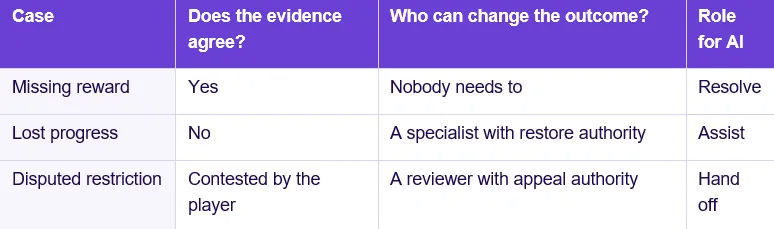
That reframes the usual debate. The goal is not to push AI as far into the queue as it will go. It is to put AI exactly where the evidence is clean and the decision is already made, and to make the moment it steps back feel like progress rather than a dead end.
The AI-to-human handoff test
Most AI support experiences are judged at the handoff, because that is where players decide whether they were helped or processed. Run any AI flow through these five checks:
- No repeat telling. Does the human receive everything the player already said, so the player never starts again?
- No hidden promises. Can the human see exactly what the AI told the player, including any timelines or expectations it set?
- An honest reason. Does the player know why they are being handed on, in plain words, without it sounding like a brush-off?
- A named next step. Is there an owner, a clear next action and a way for the player to check progress?
- A hard edge. Is the AI prevented from promising outcomes it has no authority over, such as refunds, restores or reversed penalties?
If a flow fails check one, the player pays for it in time. If it fails check two or five, the player pays for it in trust. Behind all five sits a question no flow diagram can answer: who is on the receiving end of the handoff?
Where this leaves AI in player support
None of this makes AI less useful. It makes it more useful, because a well-bounded AI can take the clean cases fast, prepare the messy ones properly and protect human time for the moments that carry emotion, fairness or money. Done well, AI (and automation) protects human support. It does not replace it.
The human on the other side matters too. When the case lands with someone who plays the game, understands what that lost weekend or that restriction means, and has the authority to act, the handoff stops being a queue transfer. It becomes the point where the player feels heard.
This is the thinking behind Fan-Made CX at 5CA. Player support works best when it is fan made: delivered by people who play, who care about the game and who know its community from the inside, supported by tools that give them more time and better context. Technology can prepare the case, but only a fan can recognise what it means to the player. That is what turns a resolved ticket into a player who feels looked after.